What it runs on: accelerators, memory, advanced packaging, networking and optics, chip supply.
8 facts published from 3 filers, latest Nov 3, 2026
How it works
AI runs on accelerators, the high-bandwidth memory stacked beside them, the packaging that joins them and the networks that link thousands of them. Each step is made by a handful of companies, and several report demand above what they can supply34.
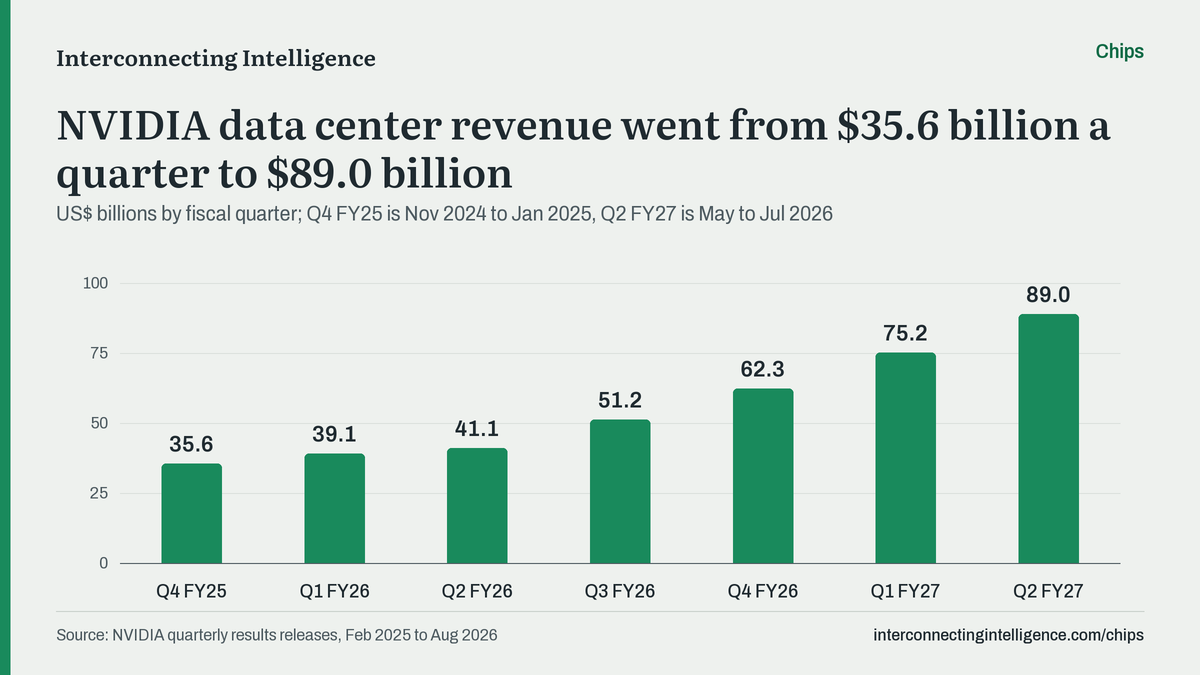
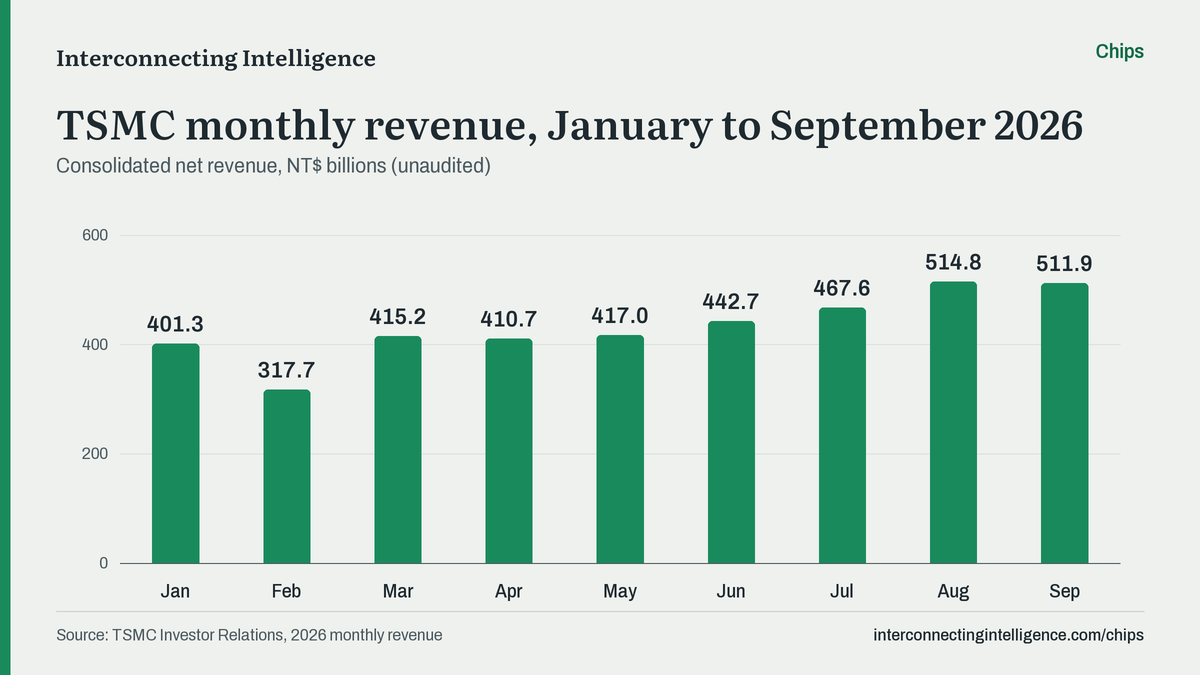
NVIDIA reported data center revenue of $89.0 billion for the quarter ended July 26, 2026, up 117% from a year earlier1. TSMC's revenue for July to September 2026 was US$46.72 billion, up 41.2%, with high-performance computing 68% of the total2. Global semiconductor sales were $159.7 billion in August 2026 on a three-month average, up 144.3% from a year earlier8.
Download imageSized for X and LinkedIn, with source and address included.Show the data
Fiscal quarter
Months
Data center revenue
Q4 FY25
Nov 2024 to Jan 2025
$35.6 bn
Q1 FY26
Feb to Apr 2025
$39.1 bn
Q2 FY26
May to Jul 2025
$41.1 bn
Q3 FY26
Aug to Oct 2025
$51.2 bn
Q4 FY26
Nov 2025 to Jan 2026
$62.3 bn
Q1 FY27
Feb to Apr 2026
$75.2 bn
Q2 FY27
May to Jul 2026
$89.0 bn
How an AI chip gets made
Design. A chip company, or a cloud company working with a custom-chip partner, designs the accelerator.
Wafer fabrication. A foundry prints the design onto silicon wafers using leading-edge processes. TSMC has kept its 2026 capital budget at US$60 billion to US$64 billion3.
Memory. Memory makers stack DRAM dies into high-bandwidth memory. SK hynix says long-term agreements with 14 customers cover more than half of its 2027 and 2028 production capacity4.
Advanced packaging. The accelerator and its memory stacks are joined into one package. TSMC said its CoWoS and SoIC packaging capacity is expected to grow more than 80% a year through 2027, as reported by Taiwan's CNA5.
Servers. Manufacturers build the packaged chips into boards, servers and full racks with power and cooling.
Networking. Racks are linked with switches and copper or optical connections. NVIDIA's networking revenue was $14.8 billion in February to April 2026, up 199% from a year earlier6.
Download imageSized for X and LinkedIn, with source and address included.Show the data
Month
Revenue (NT$ million)
Change from a year earlier
Jan 2026
401,255
+36.8%
Feb 2026
317,657
+22.2%
Mar 2026
415,191
+45.2%
Apr 2026
410,726
+17.5%
May 2026
416,975
+30.1%
Jun 2026
442,680
+67.9%
Jul 2026
467,580
+44.7%
Aug 2026
514,806
+53.3%
Sep 2026
511,857
+54.6%
Terms
Accelerator
A processor built to run AI calculations in parallel, such as a GPU or a custom chip.
High-bandwidth memory (HBM)
Memory chips stacked vertically beside the processor so data moves between them quickly.
Advanced packaging
Methods such as TSMC's CoWoS that combine several chips, like a GPU and its memory stacks, into one package.
Foundry
A company that manufactures chips designed by others.
Wafer
A thin silicon disc, usually 300 mm across, on which many chips are made before being cut apart.
Optical transceiver
A module that converts electrical signals to light and back, so data can travel over fiber between servers and switches.
Largest figures reported
From published facts in this layer, ranked within each kind of measure. They aren't added together, because two facts can describe the same capacity.
Marvell contributes $12.6 billion (FQ3'27 guidance) and Lumentum $5.1 billion (FQ1'27), on a most-recent-quarter annualized basis. Pro forma gross margin is 58% and 53% combine to 57%, and operating margin is 39%.
The combined TAM is shown as Marvell $400B plus Lumentum $90B+ for CY30. Sources cited are Marvell's October 6, 2026 Investor Day and Lumentum's March 17, 2026 OFC briefing.
The presentation says the combination pairs Marvell's interconnect with Lumentum's lasers and photonics. It cites $1B+ in run-rate synergies, primarily COGS, and expected accretion to Marvell non-GAAP EPS in year one post-close.
Installation is planned for early calendar 2027, after the customer completed a benchmark evaluation last quarter. Aehr also cites a $22 million follow-on order from its lead AI processor wafer-level burn-in customer, announced in August 2026.
The customer's second AI processor completed qualification on Sonoma, and Aehr received follow-on orders for initial production sampling ahead of an anticipated production ramp in calendar 2027.
Bookings were $46.7 million and effective backlog was $109.3 million as of November 1, 2026. Aehr raised its fiscal 2027 revenue outlook to $150 million from a prior range of $130 million to $150 million.
Growth is led by hyperscalers and large service providers in the U.S. Demand is driven by transport capacity expansion, cloud wholesale connectivity and hyperscale DCI.